2026
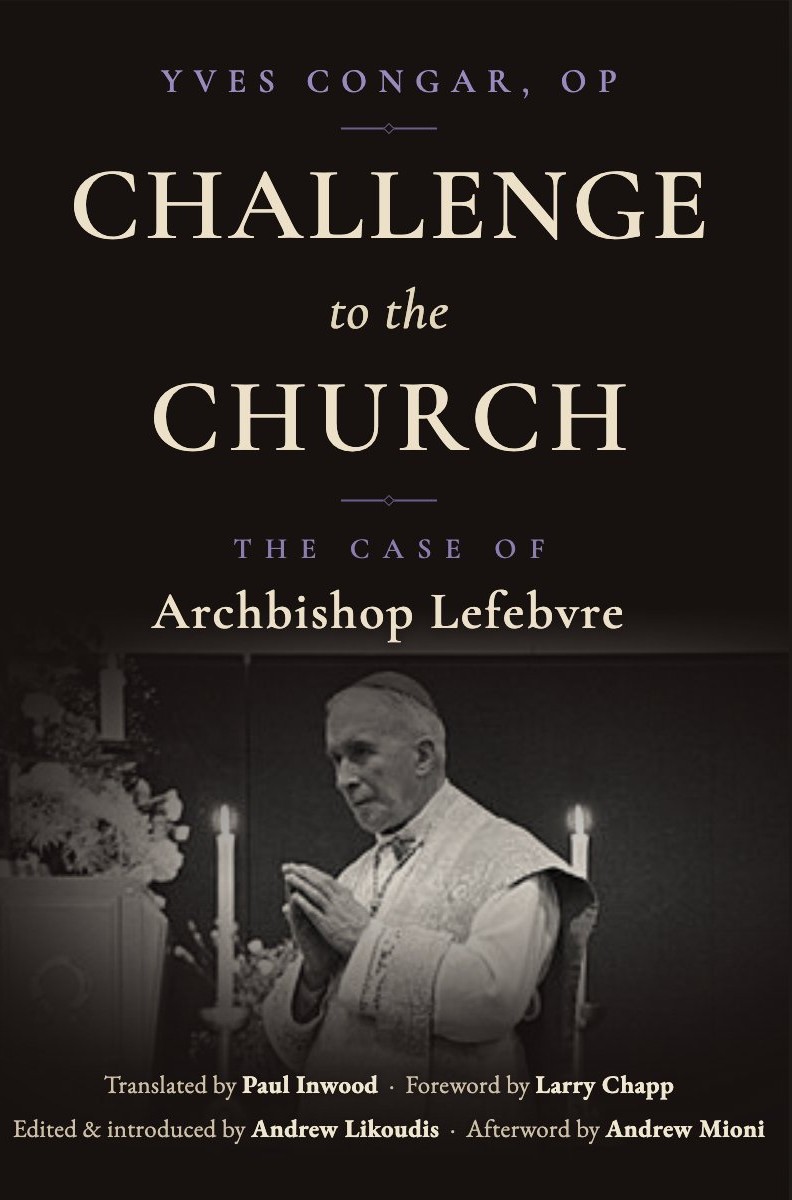
Challenge to the Church
The Case of Archbishop Lefebvre
The fiftieth-anniversary edition of Congar’s 1976 answer to Archbishop Lefebvre, published on July 1, 2026, the day Ecône proceeded to a second round of illicit episcopal consecrations.
About the Book
In 1976, as Archbishop Marcel Lefebvre’s defiance of Rome broke into open crisis, the Dominican ecclesiologist Yves Congar, OP, whose work shaped the Second Vatican Council, answered with this short, penetrating book. Congar shows that what Lefebvre refused was nothing less than the authority of the Church and her understanding of her own nature, and he traces the deeper crisis behind the Ecône movement.
Published on the fiftieth anniversary of its first appearance, this new edition reprints Paul Inwood’s 1977 translation with fresh introductory and closing matter. It appeared on July 1, 2026, the day Ecône proceeded to a second round of illicit episcopal consecrations. Congar’s case for Tradition as the living faith of the Church, not a frozen monolith, speaks directly to a wound that has never closed.
Watch
Praise for the Fiftieth-Anniversary Edition
“I welcome the publication of this new edition of Congar’s important and frank treatment of the schismatic Archbishop Lefebvre. One dares to hope that bishops and other Church leaders will read this work as they respond to a new challenge to the unity and peace of the Church.”
Rev. Gabriel Flynn, DPhil (Oxon)Co-editor of Ressourcement: A Movement for Renewal in Twentieth-Century Theology (Oxford University Press); author of Yves Congar’s Vision of the Church in a World of Unbelief; editor of Yves Congar: Theologian of the Church
“Here is a new edition of a penetrating book by Congar, which comes at just the right time. Written in simple language, it provides the essential insights needed to understand the errors and dead ends of Archbishop Lefebvre’s schismatic movement.”
Fr. Joseph Famerée, SCJProfessor Emeritus of Theology, UCLouvain; author of L’ecclésiologie d’Yves Congar avant Vatican II
“As Congar points out, the SSPX has chosen the path of Ignaz von Döllinger and, even more, the ‘Old Catholics.’ They, too, argued that it was the pope and Council that erred and that changed; they, too, claimed that they were Catholic and the Church under the pope, having embraced the Council, was aberrant. Congar’s reflections on the rites of the Mass, too, are still instructive today, in an era of ritual absolutism–as are his reflections on ecumenism and religious freedom. And he fully recognizes the crisis, even if his diagnoses and solutions would today need to engage even more fully with doctrinal liberalism and perspectivalism, a superficial liturgical and moral life, and the politicization of Christ and eschatology.”
Matthew Levering, PhDJames N. Jr. and Mary D. Perry Chair of Theology, Mundelein Seminary
“An entrenched, and often intransigent, schismatic attitude has long been a sad fact of the SSPX’s existence and way of operating. Although I have my theological differences with Fr. Congar (later Cardinal Congar), he was a man of the Church, and in this book he provides a voice and a message whose details could have been written today just as readily as when they were penned amid an earlier crisis vis-à-vis the Society. In the hope of a rapprochement that leads to the Society’s real and living recognition that it is called to live not the life of separatists but one of true and unfeigned ecclesial communion, I commend this little book to the reflection of today’s readers.”
Matthew K. Minerd, PhDManaging Editor, Encyclopedia of Catholic Theology (ECT.org)
“A new edition of Congar’s book is welcome. Not because the situation today is exactly that of when the book was first published in 1976. It isn’t. Not exactly. A lot of holy and not so-holy water has flowed under the ecclesiastical bridge. On the one hand, the pontificates of John Paul II, Benedict XVI, and Francis affect how we read the book today. On the other, so do controversies with hardline critics who identify as “Traditionalists.” Yet Congar’s fundamental message remains. Reform of the Church’s life, including the Sacred Liturgy, brings with it certain tensions. Conversion always does. Often for both or many sides of an ecclesiastical controversy. This book can help reduce tensions, and foster conversion, if its message is heeded.”
Mark BrumleyPresident of Ignatius Press; author of The Seven Deadly Sins of Apologetics; editor of A Study Guide for Jesus of Nazareth: Holy Week
“Few books published in the aftermath of the Second Vatican Council have proven as enduringly relevant as Challenge to the Church. Fifty years ago, Yves Congar clearly identified and challenged the doctrinal errors and warped ecclesiology that continue to afflict the Lefebvrist movement even today. Congar’s analysis remains both prophetic and indispensable for anyone seeking to understand the historical roots of radical traditionalism and the Church’s ongoing struggle for unity after Vatican II.”
Mike LewisFounder and Managing Editor, Where Peter Is
“Challenge to the Church: the Case of Archbishop Lefebvre is as relevant today as it was in 1976. The attacks on the Second Vatican Council have regrettably increased since then, and traditionalism has gained an undeserved respectability. Congar, deeply conversant with the Council and its aims, addresses the traditionalists’ accusations with erudition, objectivity, and above all a love of the People of God. He treats the Lefebvre case with a care and courtesy Lefebvre’s supporters rarely reciprocate. In these days when the politics of polarization has infiltrated the sanctuary, it is refreshing to read a man whose overarching concern is communion based on love.”
Gary CampbellFormer priest of the Society of St. Pius X
“‘You cannot be the Church opposed to the Church.’ Such was the painful and prophetic appeal that Fr Congar addressed to Archbishop Lefebvre in 1976, just as the latter was embarking on the spiral of blindness and disobedience that would lead to a grave act of schism. The Dominican theologian pinpointed this contradiction at work within the SSPX: how can one defend Tradition by means unknown to Tradition and contrary to Tradition? Pitting ‘eternal Rome’ against ‘neo-modernist and neo-Protestant Rome’ stems from dangerously innovative and idealistic presuppositions, contrary to the realism of the one Church of Christ, concretely founded on the rock of Peter and on the unanimous communion of the whole episcopal college. Fifty years on, Congar’s appeal has lost none of its force. Following his example, let us not be afraid to awaken consciences and enlighten minds.”
Fr. Henry Donneaud, OPDean of the Faculty of Theology, Institut Catholique de Toulouse; editorial committee, Revue thomiste
“Yves Congar offers a masterful and deeply charitable examination of one of the most consequential ecclesial controversies of the twentieth century. With theological precision and pastoral wisdom, he challenges readers to embrace both fidelity to tradition and obedience to the living Church.”
Sebastian Mahfood, OP, PhDPresident of En Route Books and Media